Visual Evidence & Image Verification Platform
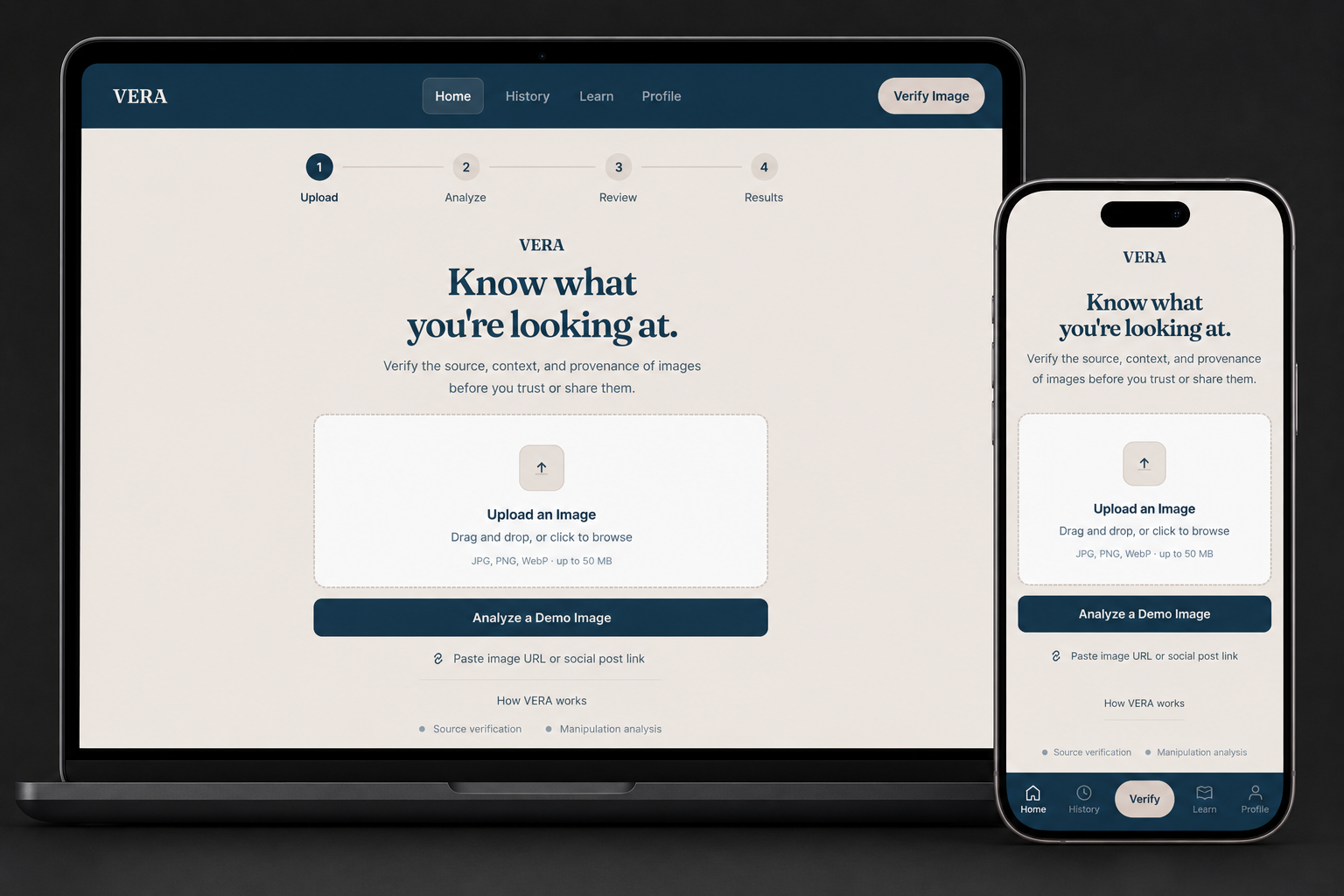
VERA is a responsive web platform that helps people evaluate the credibility of images before trusting or sharing them. Rather than giving a simple “real or fake” verdict, VERA brings together source history, contextual evidence, image analysis, and provenance to show what is supported, what is uncertain, and what remains unverified.
Role: Product Designer · UX Designer (solo)
Platform: Responsive Web
Tools: Figma · Figma Make
Platform: Responsive Web
Tools: Figma · Figma Make

Why I built this
VERA grew out of survey research I conducted on how exposure to AI-generated conflict imagery influences public trust and emotional engagement.
The survey recorded 51 responses, with participation varying across questions. One of the clearest findings was that 22 of 26 respondents agreed or strongly agreed that AI-generated conflict imagery makes it harder to trust visual documentation of real events.
The research also showed that people weren't relying on a single signal when deciding whether to trust an image. Participants described checking original sources, comparing multiple sources, considering whether an image had been altered or AI-generated, and thinking critically before sharing.
That changed the problem for me.
As a photographer and multimedia artist, I've spent years working with images as documentation, evidence, memory, and storytelling. Generative AI complicates that relationship — but detecting AI alone doesn't solve the larger issue of visual trust.
A real photograph can still be misleading if it's shared with the wrong date, location, or event. An edited photograph isn't automatically deceptive. And missing metadata doesn't automatically mean an image is fake.
So instead of asking:
“How can I detect whether an image is AI-generated?”
I asked:
How might we help people evaluate the evidence behind an image before deciding whether to trust or share it?
That became VERA.
Research → design opportunity
My research suggested that the challenge wasn't simply AI detection. It was uncertainty around visual evidence.
Participants were already using multiple strategies to decide what to trust: checking sources, looking for corroboration, considering manipulation, and comparing information before sharing.
That gave me the foundation for the product:
Research finding
AI-generated imagery can make visual documentation harder to trust.
AI-generated imagery can make visual documentation harder to trust.
↓
Behavior
People look for multiple signals before deciding what to believe.
People look for multiple signals before deciding what to believe.
↓
Design opportunity
Bring those signals together and make uncertainty understandable.
Bring those signals together and make uncertainty understandable.
↓
VERA
Source · Context · Image Analysis · Provenance
Source · Context · Image Analysis · Provenance
The survey didn't directly test these four product categories. They are my design response to the behaviors and trust problem identified through the research.


The problem
Image verification is fragmented.
Someone questioning an image may need to search for its original source, perform a reverse-image search, compare news coverage, inspect metadata, look for manipulation, and verify the location or context, often across multiple tools.
And even after doing all of that, the answer may not be binary.
An image might have strong contextual support while its original source remains unknown. Automated analysis might detect an anomaly without being able to determine what caused it.
VERA is designed around that uncertainty.
Report evidence, not verdict.
What I decided to build
Five goals shaped the product:
Bring verification signals together, source, context, image analysis, and provenance in one experience.
Separate evidence from uncertainty, clearly show what is supported and what isn't known.
Explain every assessment, users should be able to understand why VERA reached a conclusion.
Let users investigate progressively, start with a summary, then reveal deeper evidence when needed.
Bring verification into the sharing decision, surface unresolved issues before an image continues circulating.
The goal wasn't to make VERA decide what is true.
It was to give the user enough context to make a more informed judgment.


Process
Research → Define → Ideate → Design → Prototype → (Test)
I began with survey research into AI-generated conflict imagery and visual trust. I translated the findings into a broader product problem around image verification, then mapped the information users might need when evaluating an image.
From there, I designed the information architecture and core flows in Figma and built an interactive prototype in Figma Make.
The process also changed the original concept. What began around AI-image detection developed into a system centered on evidence, context, provenance, and uncertainty.
Usability testing is the next step and has not yet been completed.
User journey → structure
Upload → Analyze → Assess → Investigate → Compare → Decide → Share
I deliberately didn't end the journey at Analyze.
The analysis is only the beginning. The user needs to understand what the result means, inspect the evidence if necessary, and decide what to do with that information.
That journey produced the main VERA experience:
Verify · Evidence Report · Evidence Review · Compare Image · Provenance · Before You Share

Evidence Report
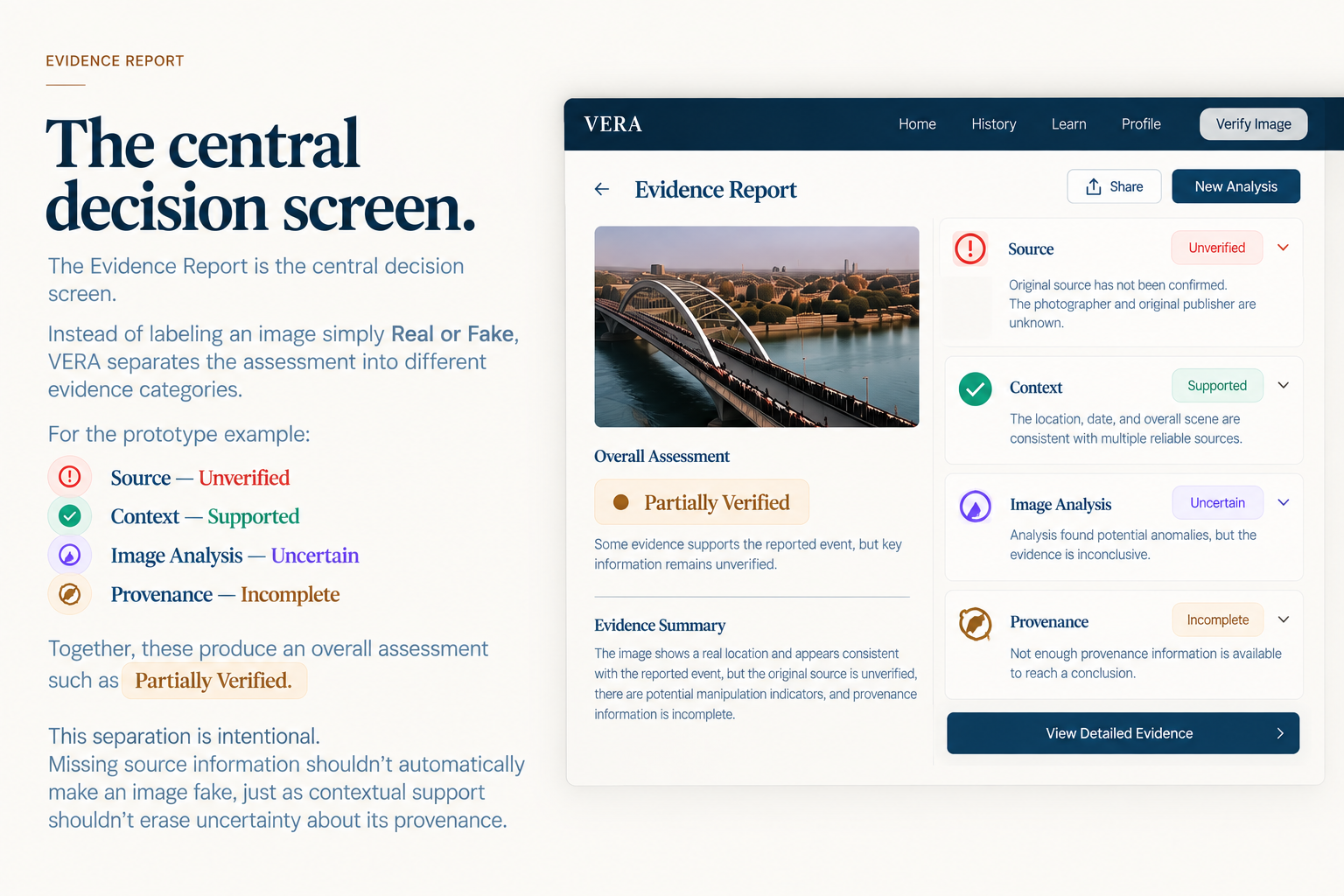
The Evidence Report is the central decision screen.
Instead of labeling an image simply Real or Fake, VERA separates the assessment into different evidence categories.
For the prototype example:
Source — Unverified
Context — Supported
Image Analysis — Uncertain
Provenance — Incomplete
Context — Supported
Image Analysis — Uncertain
Provenance — Incomplete
Together, these produce an overall assessment such as Partially Verified.
This separation is intentional.
Missing source information shouldn't automatically make an image fake, just as contextual support shouldn't erase uncertainty about its provenance.
Explainable verification
A label like Partially Verified still isn't useful if the system doesn't explain why.
So every major assessment has a path to deeper evidence.
For example, users can investigate:
Original Source
Earliest located instance · Reverse image search · EXIF metadata
Earliest located instance · Reverse image search · EXIF metadata
Independent Evidence
News coverage · Related imagery · Contextual corroboration
News coverage · Related imagery · Contextual corroboration
Image Analysis
Error Level Analysis · Noise analysis · Generative AI detection
Error Level Analysis · Noise analysis · Generative AI detection
Location & Context
Geolocation · Shadow and lighting · Environmental conditions
Geolocation · Shadow and lighting · Environmental conditions
The information architecture therefore moves progressively:
Assessment → Reason → Evidence
Users can stop at the summary or continue investigating.


Designing for uncertainty
One of the most important UX decisions was avoiding a binary vocabulary.
VERA uses states including:
Supported · Uncertain · Unknown · Unverified · Incomplete
Each communicates something different.
If metadata is unavailable, VERA reports it as Unknown rather than treating its absence as evidence of manipulation.
If automated analysis identifies an anomaly but cannot confidently explain it, the result remains Uncertain.
The product is designed to communicate the limits of what the system knows, not hide them.
Before You Share
Verification becomes most useful at the moment someone decides what to do next.
Before a user shares an image with unresolved evidence, VERA surfaces the most important issues again:
Original source has not been confirmed
Possible manipulation requires additional verification
The user can then choose to View Evidence First or Share Anyway.
I deliberately chose not to block sharing. VERA provides information and friction at the decision point, but leaves the final judgment with the user.
An optional Add verification context to share feature also allows the evidence summary to travel with the image.


What I chose not to build
A Real/Fake verdict. The evidence often doesn't support that level of certainty.
A single authenticity percentage. A precise number can communicate more certainty than the underlying evidence deserves.
Automatic blocking. VERA supports the user's judgment rather than replacing it.
AI detection as the entire product. AI analysis is one signal alongside source, context, and provenance.
Hidden reasoning. Important assessments should always lead back to evidence.
How I'd measure it
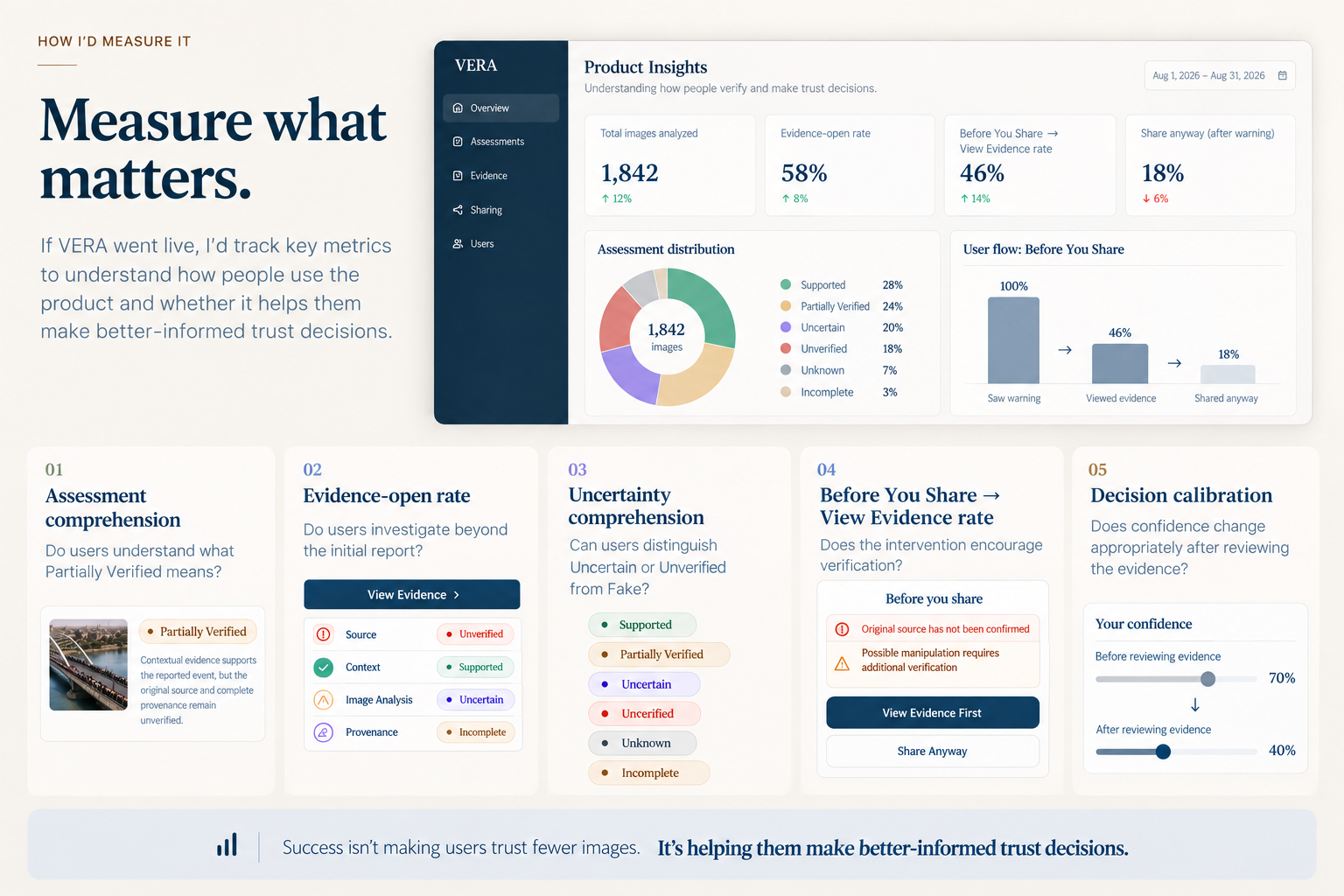
If VERA went live, I'd watch:
Assessment comprehension, do users understand what Partially Verified means?
Evidence-open rate, do users investigate beyond the initial report?
Uncertainty comprehension, can users distinguish Uncertain or Unverified from Fake?
Before You Share → View Evidence rate, does the intervention encourage verification?
Decision calibration, does confidence change appropriately after reviewing the evidence?
Success isn't making users trust fewer images.
It's helping them make better-informed trust decisions.

What's next
Usability testing around comprehension, trust, and uncertainty, focused on three questions:
Do users understand Partially Verified without instruction?
Can they distinguish Supported, Uncertain, Unknown, Unverified, and Incomplete?
Does Before You Share encourage users to inspect evidence without feeling controlling?
I expect the terminology to be where the experience needs the most refinement.
Outcome
VERA started as an exploration of AI-generated imagery and trust and evolved into a broader product concept for evaluating visual evidence.
Instead of replacing trust in an image with trust in an algorithm, VERA makes the reasoning visible:
Image → Analysis → Evidence → Context → Judgment → Sharing
From asking:
“Is this image real?”
to asking:
“What evidence do I have before I trust or share it?”
