Overview
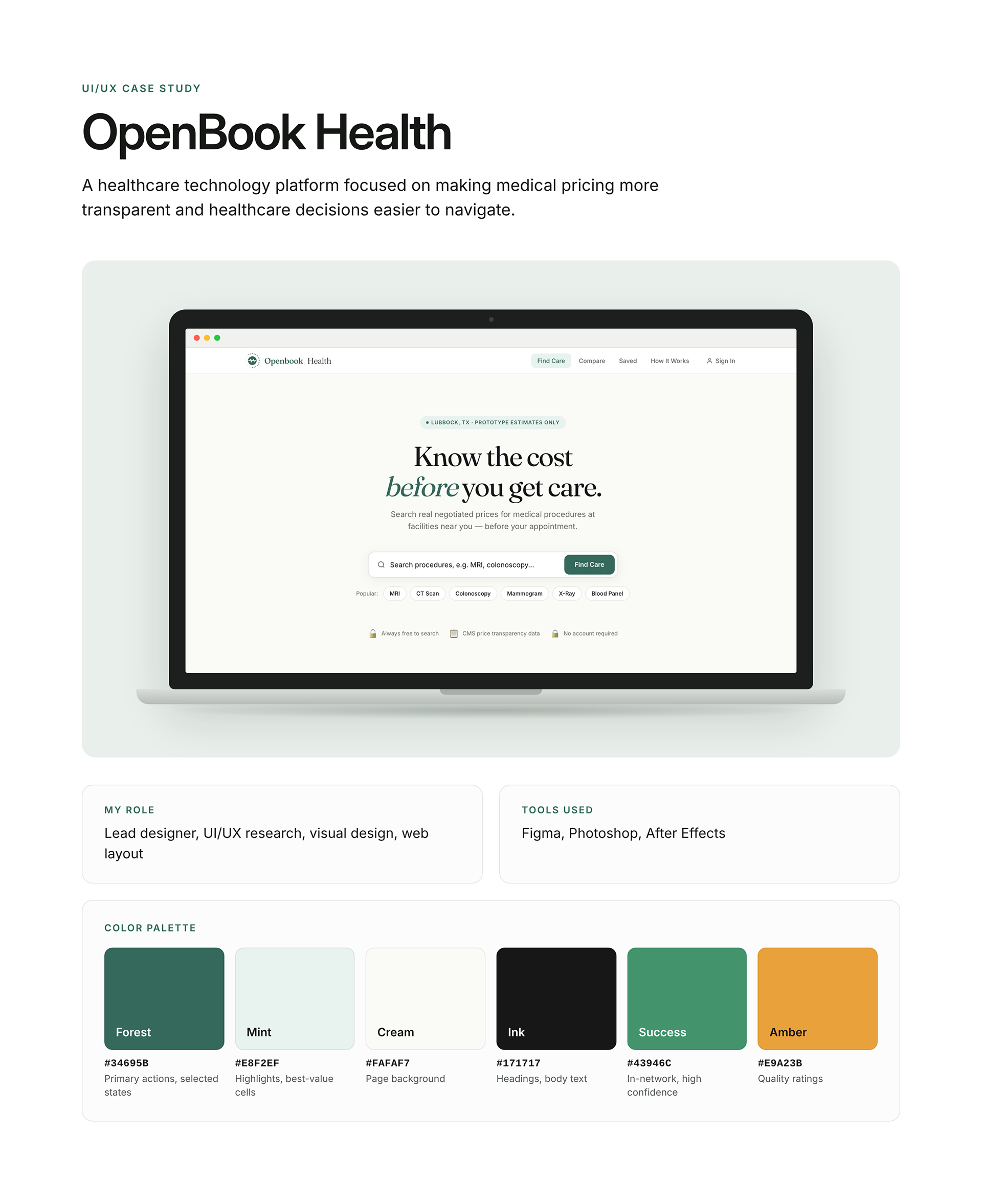
OpenBook Health is a healthcare technology platform focused on making medical pricing more transparent and healthcare decisions easier to navigate.
The platform brings together medical procedure discovery, location-based facility searches, personalized cost estimates, and side-by-side comparisons to help patients evaluate their care options.
My UI/UX work focused on translating complex healthcare information into intuitive digital experiences, from early-access onboarding and responsive landing pages to structured search journeys, comparison interfaces, and AI-assisted healthcare exploration.
The Problem
Healthcare decisions often come with uncertainty. Patients may struggle to understand the cost of a medical procedure, determine whether a facility accepts their insurance, or compare providers based on price, quality, and location.
Traditional healthcare experiences frequently require users to navigate fragmented information across multiple sources.
The design challenge: How might we make healthcare pricing easier to understand, compare, and act on without overwhelming users?
My Role:
Lead designer, UI/UX research, visual design, web layout
Lead designer, UI/UX research, visual design, web layout
Tools Used:
Figma, Photoshop, After Effects
Figma, Photoshop, After Effects

01. Early Access & Waitlist Experience
Designing the first interaction between users and OpenBook Health.
The Early Access experience was designed to introduce OpenBook's mission of healthcare price transparency while encouraging users to join the platform before its launch.
I focused on creating a responsive landing page and mobile-friendly registration experience with clear messaging, intuitive navigation, and prominent calls to action.
Key Design Decisions
Clear Value Proposition: Communicating the benefits of transparent healthcare pricing through concise messaging and visual hierarchy.
Streamlined Registration: Creating a straightforward waitlist form with clear input fields, feedback, and confirmation messaging.
Responsive Design: Adapting the experience across desktop and mobile devices while maintaining visual consistency.
Conversion-Focused UI: Using prominent calls to action to guide users toward early-access registration.
Visual Identity: Establishing a recognizable interface through deep-green tones, warm neutrals, typography, and minimal layouts.
Design Goal
Reduce friction during initial engagement, communicate trust, and create an accessible entry point into the OpenBook Health ecosystem.
02. Guided Healthcare Search
Structured the healthcare discovery journey around a progressive, step-by-step experience.
Users can search for a medical procedure, specify their location and search radius, and choose between insurance-based estimates and self-pay options.
Progress indicators, contextual guidance, and clearly defined choices help users navigate each step with greater confidence.
Personalized Facility Discovery
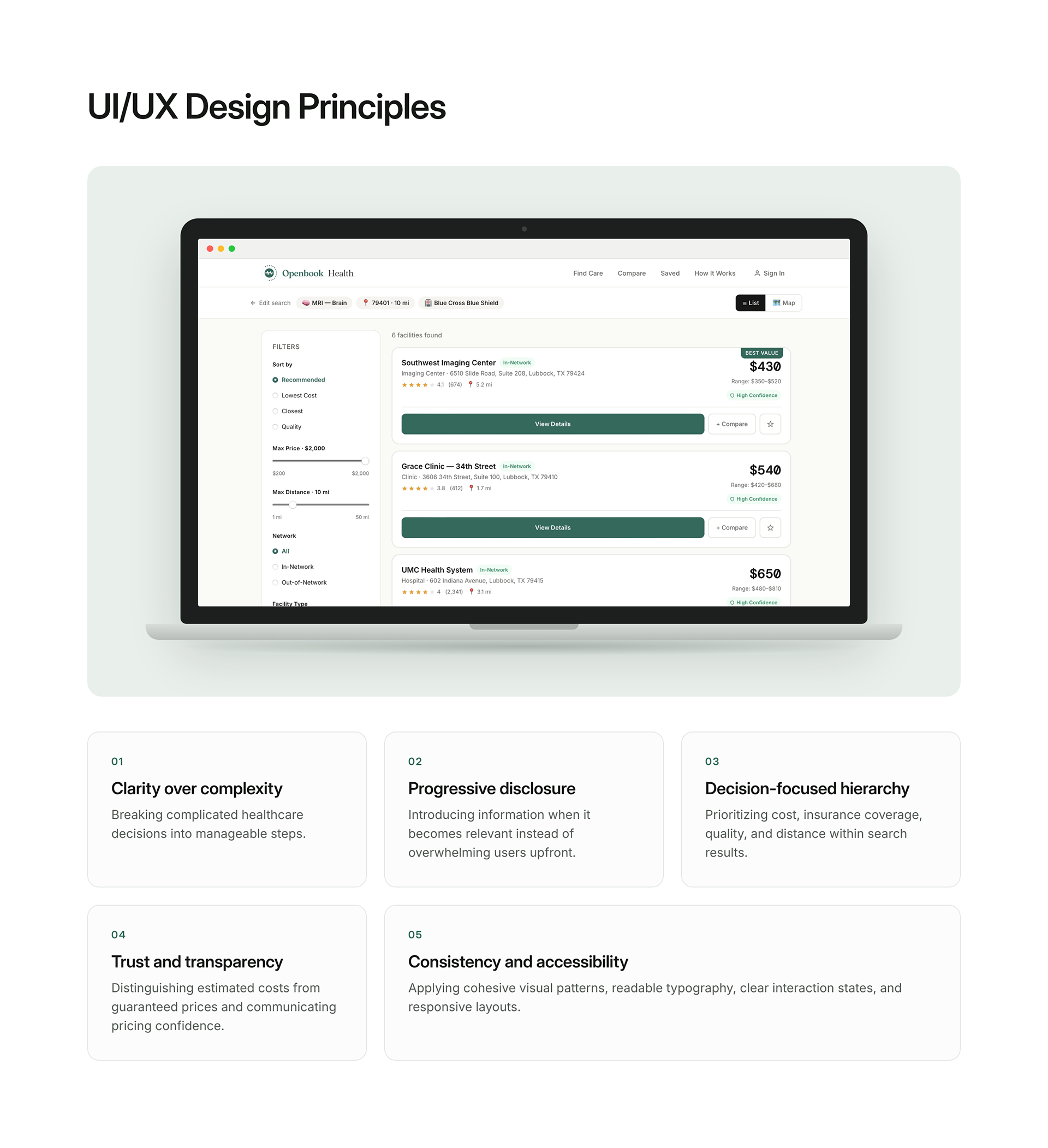
Designed a results interface that organizes healthcare options around information relevant to patient decisions.
Users can explore estimated costs, facility ratings, distance, insurance network status, and pricing confidence.
Filtering and sorting controls allow users to prioritize their needs, while list and map viewing options support different search preferences.

3. Side-by-Side Comparison
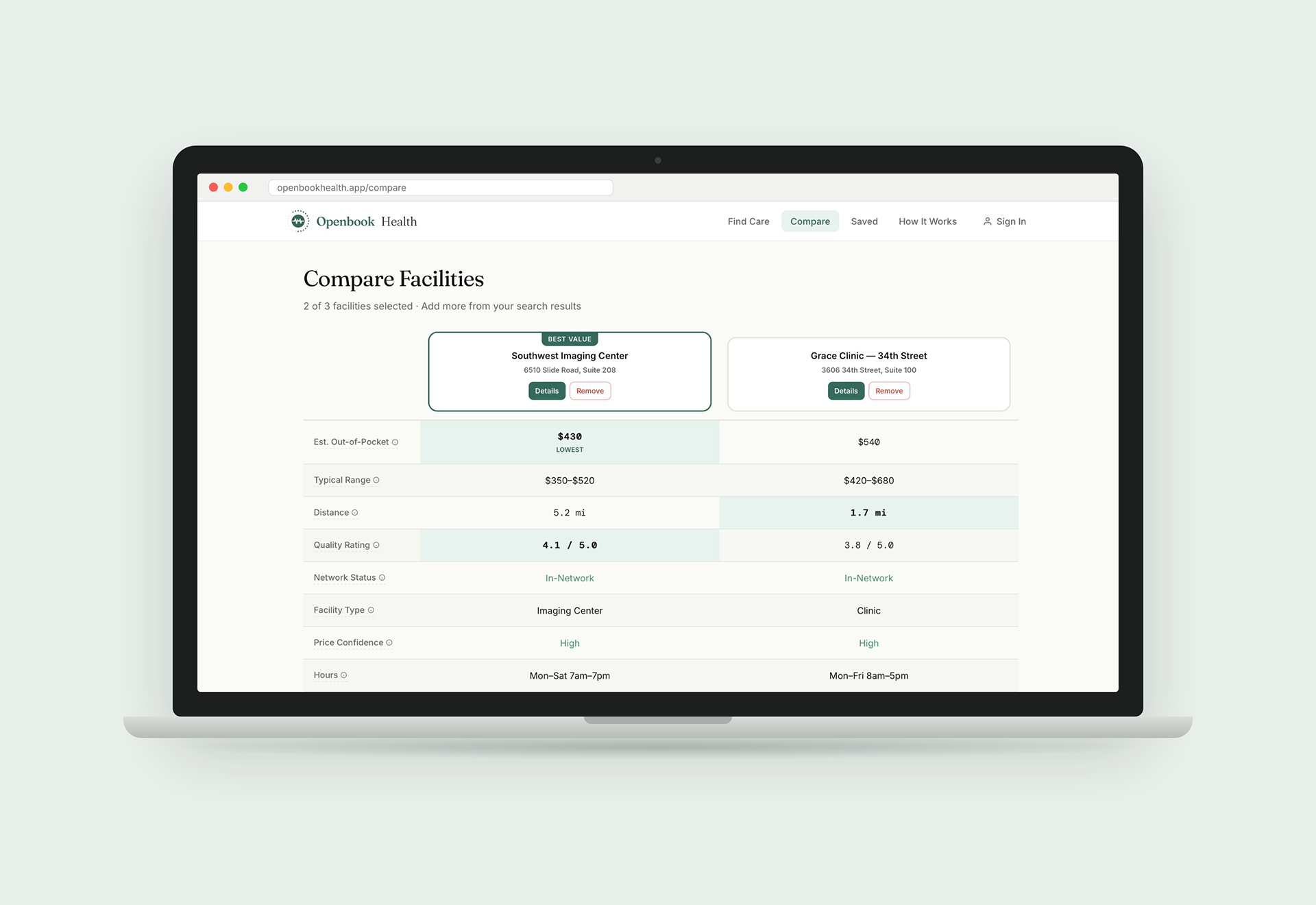
Developed a comparison experience that helps users evaluate multiple healthcare facilities within a consistent interface.
Rather than requiring users to remember information across separate pages, the comparison layout presents estimated out-of-pocket expenses, typical price ranges, quality ratings, distance, and network status together.
Visual highlights make important differences easier to identify without removing the user's ability to make their own decision.
AI-Assisted Healthcare Exploration
Explored a conversational healthcare interface that supports natural-language interaction alongside provider discovery and comparison features.
The concept combines conversational guidance with structured healthcare information, creating another way for users to navigate complex care decisions.
4. UI/UX Design Principles
Clarity over complexity: Breaking complicated healthcare decisions into manageable steps.
Progressive disclosure: Introducing information when it becomes relevant instead of overwhelming users upfront.
Decision-focused hierarchy: Prioritizing cost, insurance coverage, quality, and distance within search results.
Trust and transparency: Distinguishing estimated costs from guaranteed prices and communicating pricing confidence.
Consistency and accessibility: Applying cohesive visual patterns, readable typography, clear interaction states, and responsive layouts.
Impact
Contributed to product and onboarding improvements associated with a 15% increase in user onboarding, supporting more than 5,000 new users.
Reflection
OpenBook Health demonstrates my approach to designing information-heavy digital products: understanding the decisions users need to make, organizing complex information into clear interactions, and creating experiences that balance usability, accessibility, and business goals.
The project reinforced the importance of designing not just for task completion, but for user confidence in high-stakes decisions.