Creative Opportunity Discovery and Application Platform
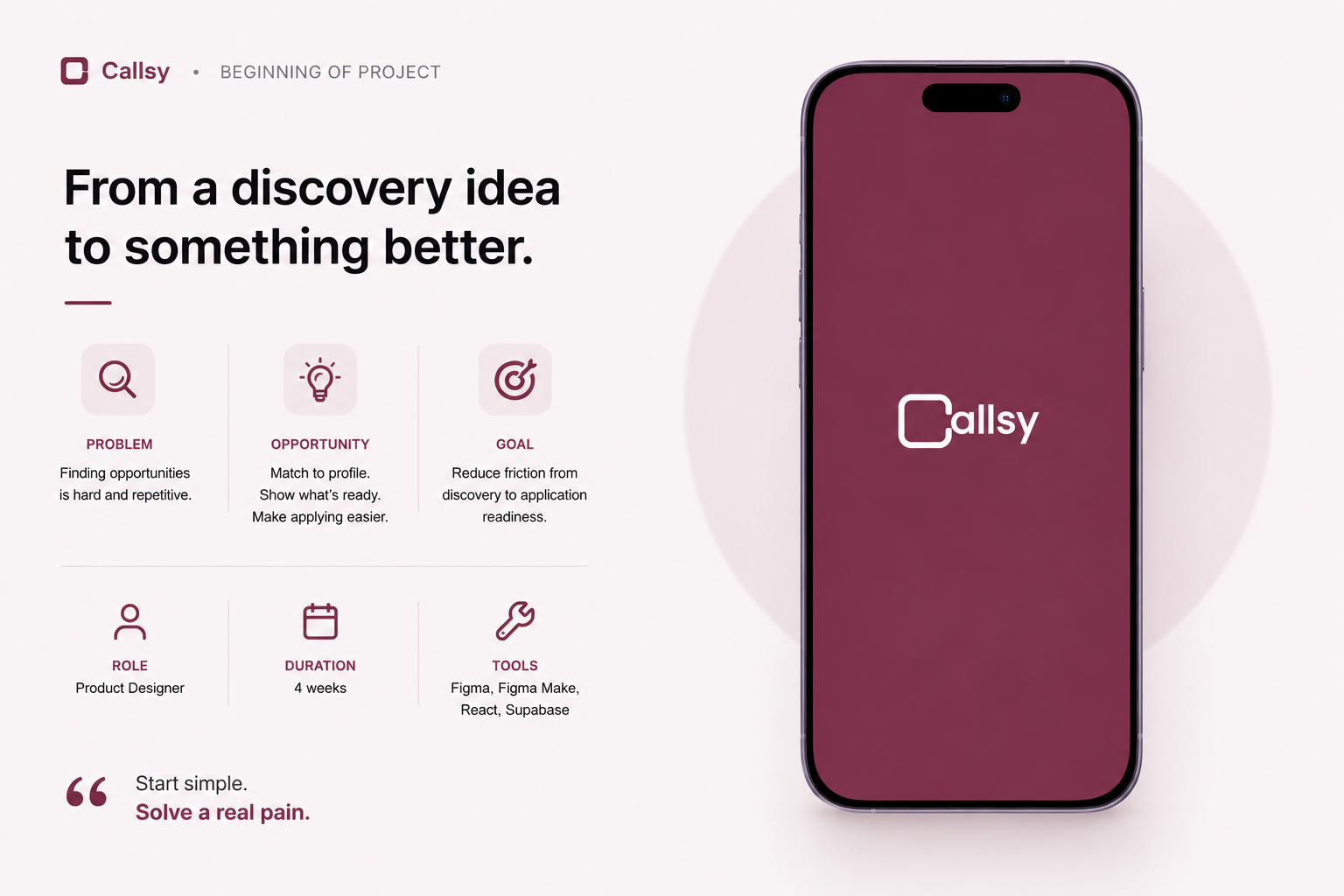
Callsy is an iOS app that helps artists find exhibitions, residencies, grants and festivals, and arrive at the application already prepared.
Role: Product Designer · UX Designer (solo) Platform: iOS Tools: Figma · Supabase Status: Working prototype with real data persistence. Usability testing not yet run.
Why I built this
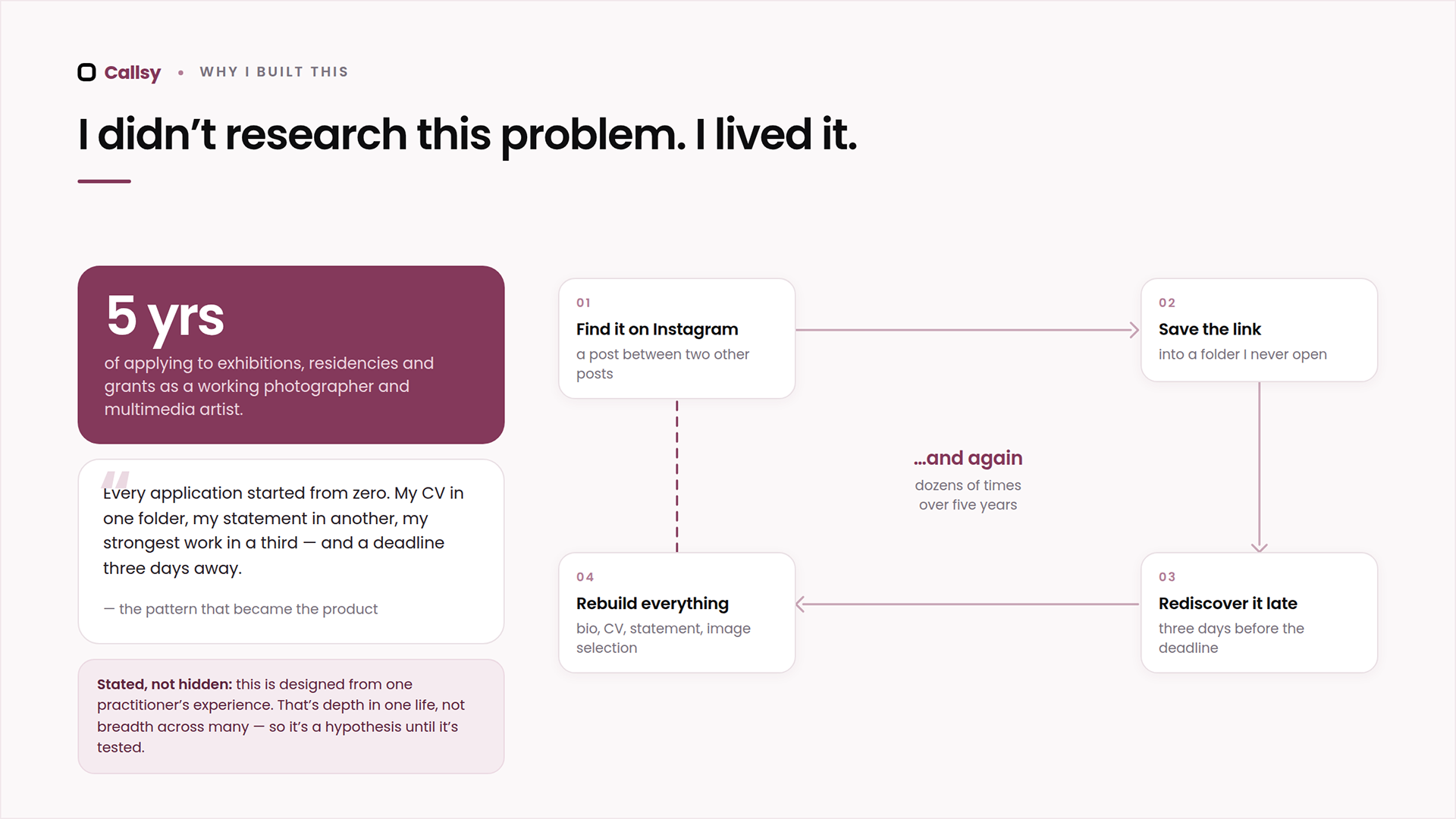
I didn't start Callsy from a research brief. I started it from five years of applying.
I'm a photographer and multimedia artist, and I've spent those years doing the same thing over and over: finding a call on Instagram, losing it in my saved posts, rediscovering it three days before the deadline, then rebuilding my bio and re-selecting portfolio images from scratch — again. My CV lives in one folder, my statement in another, my strongest work in a third. Every application starts from zero.
So the insight behind Callsy is first-hand rather than interview-derived. That's a deliberate position, and it comes with a deliberate limitation, which I state at the bottom of this page: I am currently my own sample size of one. What I designed from my own practice is a hypothesis, not a validated finding and the next step is to test it against other artists.
What that experience does give me is specificity. I know exactly which parts of this process hurt, because I've done them dozens of times.
The problem
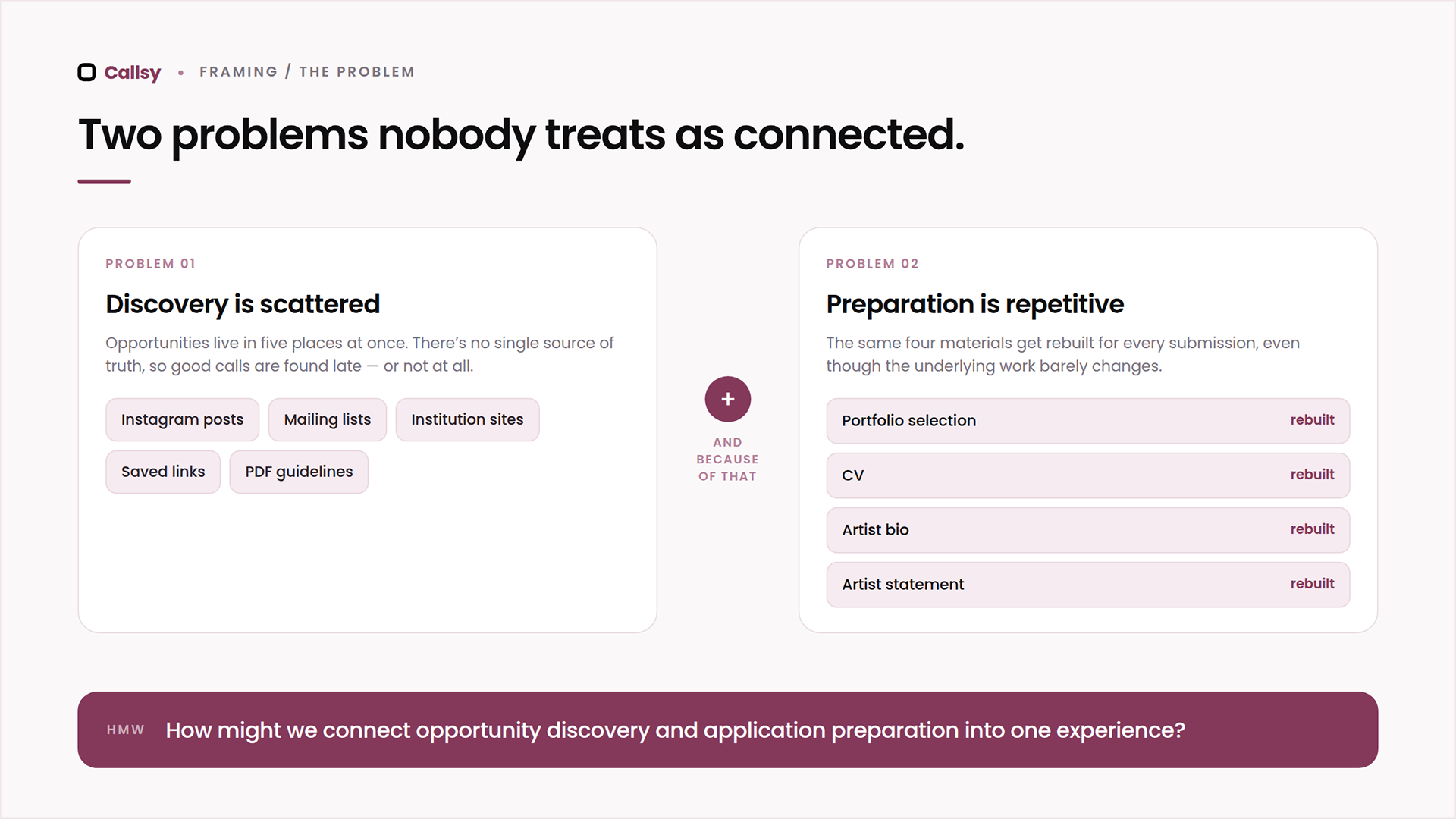
Two separate problems that nobody treats as connected:
Discovery is scattered. Opportunities live across Instagram posts, mailing lists, individual institution sites, and PDF guidelines. There's no single place to look, so good calls are found late or not at all.
Preparation is repetitive. Portfolio, CV, bio and statement get rebuilt for every submission, even though the underlying material barely changes.
The second problem is why the first one matters. Finding an opportunity is only useful if you have the energy left to apply to it.
How might we connect opportunity discovery and application preparation into one experience?
What I decided to build
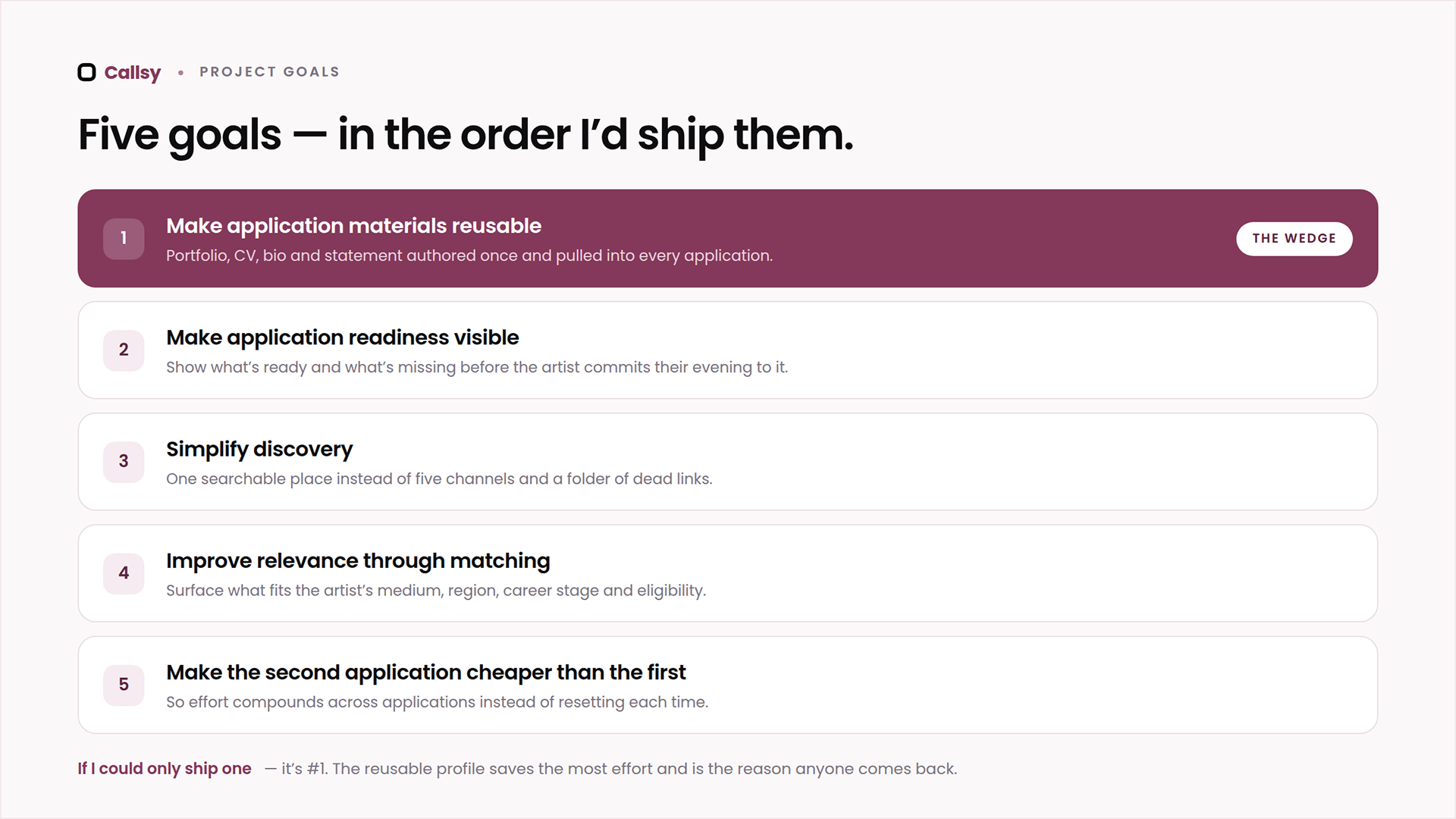
Five goals, in the order I'd ship them:
Make application materials reusable the wedge. Everything else is easier once this exists.
Make application readiness visible show what's ready and what's missing before the artist commits.
Simplify discovery one searchable place instead of five channels.
Improve relevance through matching surface what actually fits.
Reduce the cost of the second application so momentum compounds instead of resetting.
If I could only build one, it would be #1. The reusable profile is both the thing that saves the most effort and the thing that makes the artist come back.
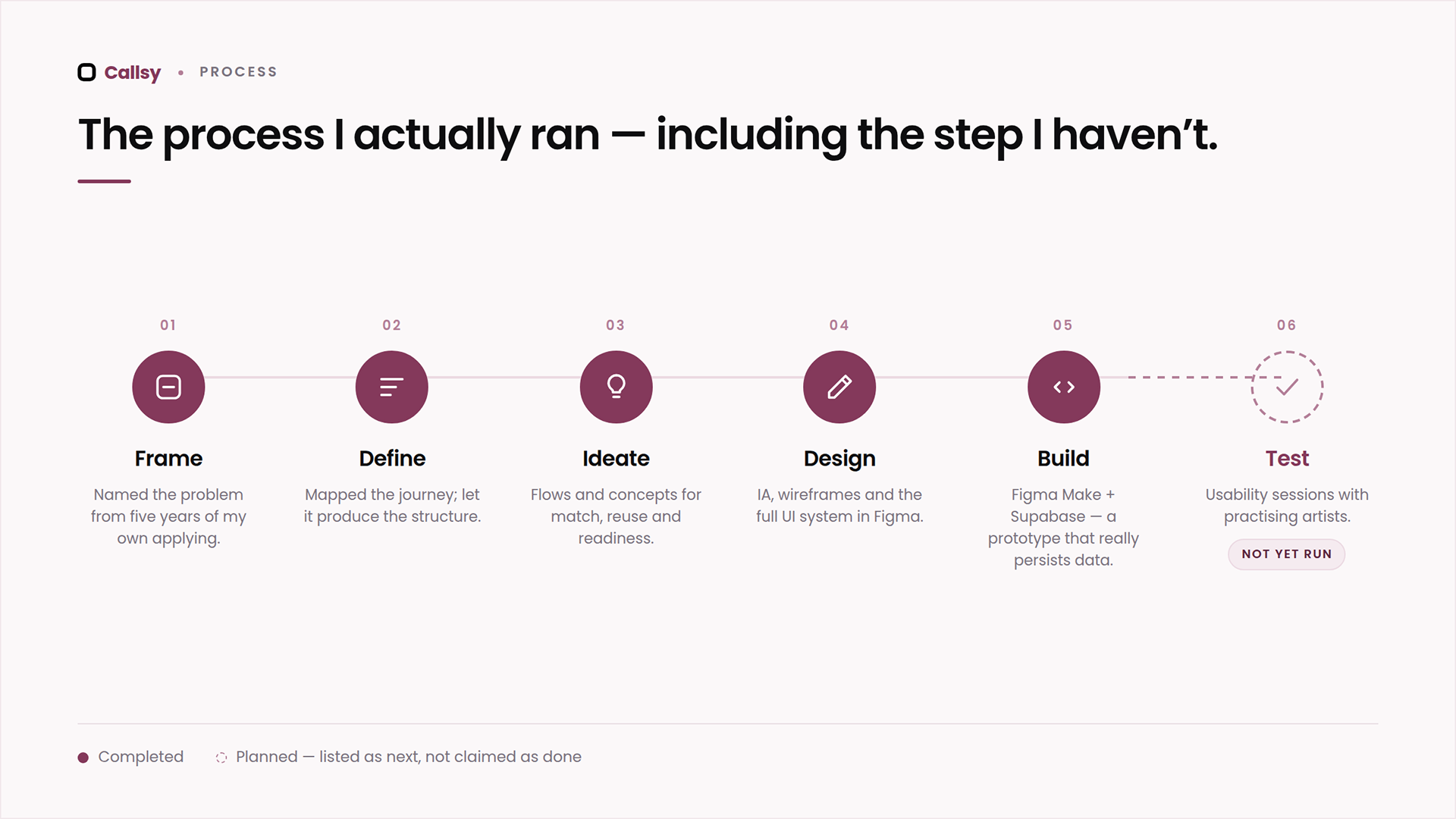
Process
Frame → Define → Ideate → Design → Build → (Test)
I framed the problem from my own practice, defined the structure through a journey map, designed the flows and UI in Figma, then built a working prototype in Figma Make with Supabase behind it so profile data, saved opportunities and applications actually persist between sessions.
Usability testing is the step I haven't done yet. I've listed it as next, not as complete.
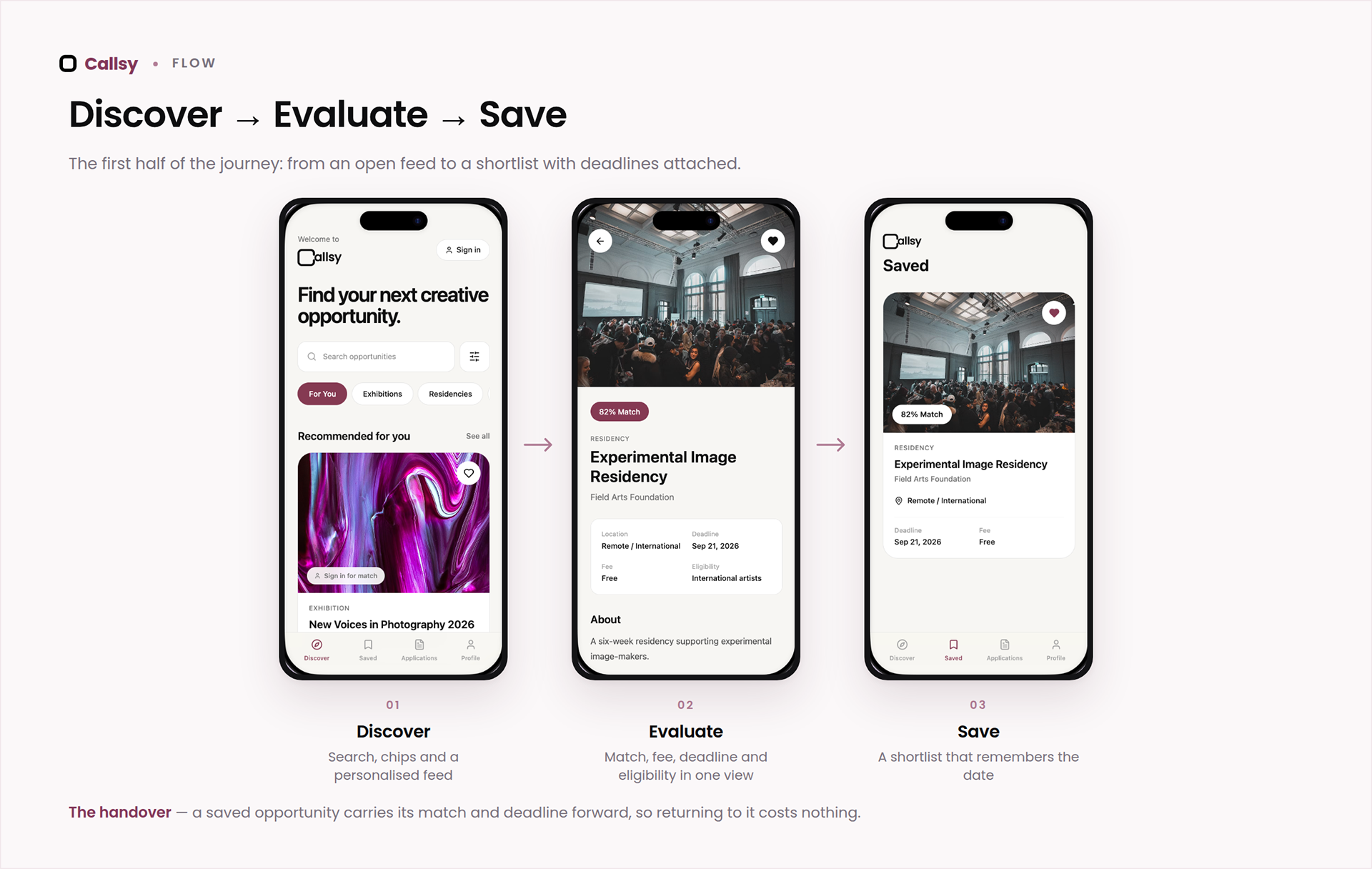
User journey → structure
Discover → Evaluate → Save → Prepare → Apply
Mapping this journey is what produced the app's structure. The drop-off in my own experience always happened between Save and Prepare — the point where intent exists but the effort of assembling materials kills it.
That journey gave Callsy four primary areas:
Discover · Saved · Applications · Profile
Profile sits last in the tab bar but first in importance: it's the layer the other three draw from.
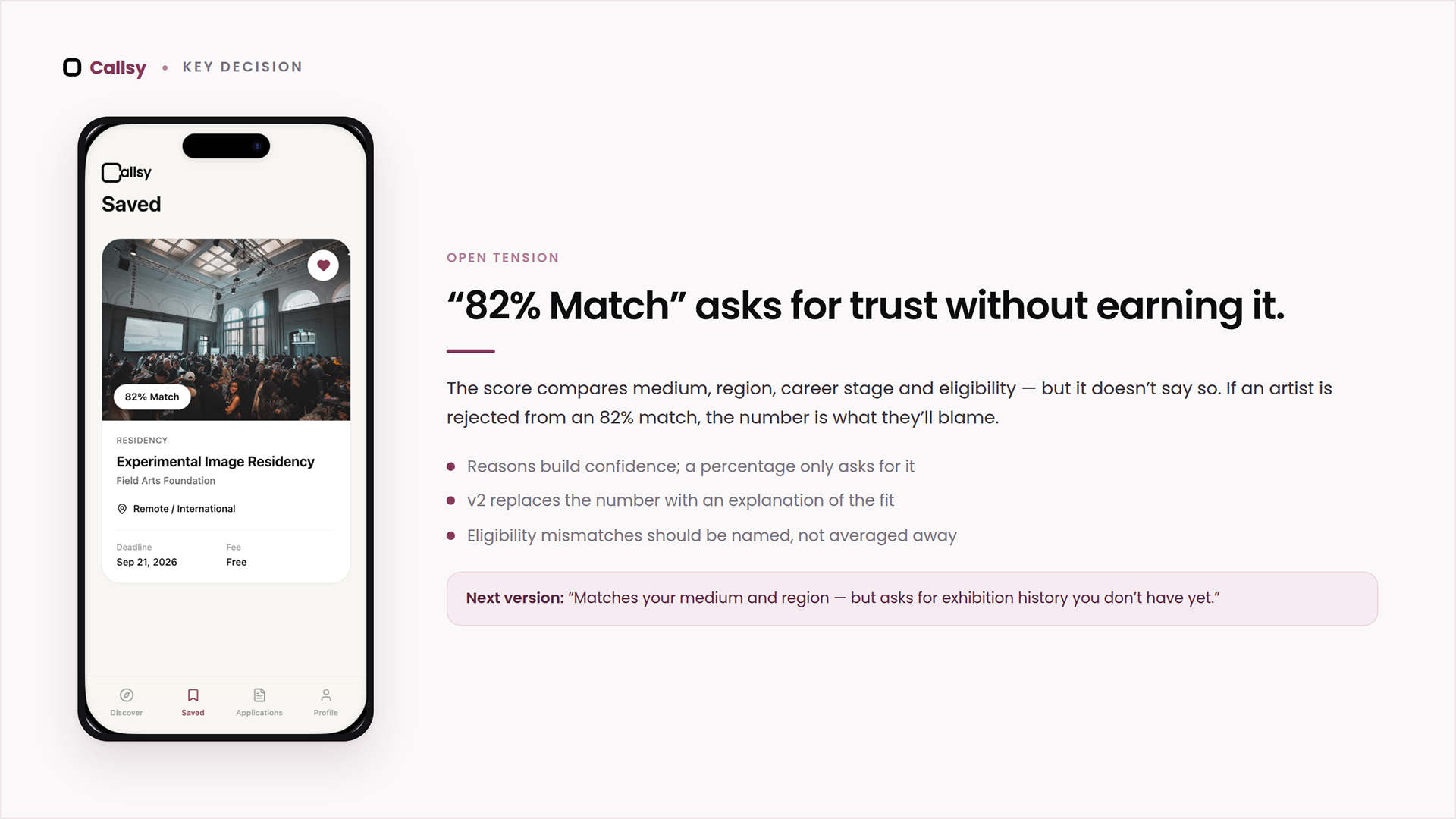
Discover & Match
Artists can browse, search and filter opportunities by type, fee and relevance. A Match Score compares an opportunity against the artist's stated medium, opportunity type, location, career stage and eligibility.
A decision I made: the Match Score is hidden until sign-in. Browsing works without an account, but every card shows "Sign in for match" instead of a percentage. The score is only meaningful once there's a profile to compare against — showing a number derived from nothing would be worse than showing none. It also gives the sign-up prompt an honest reason to exist.
A tension I'm still holding: a bare percentage — "82% Match" — asks for the artist's trust without earning it. It doesn't say why, and if an artist is rejected from an 82% match, the number is what they'll blame. The honest version of this feature explains itself: matches your medium and region, open to emerging artists, but asks for exhibition history you don't have yet. Reasons build confidence; a percentage only asks for it. Making the score explainable is the change I'd prioritise in the next version.
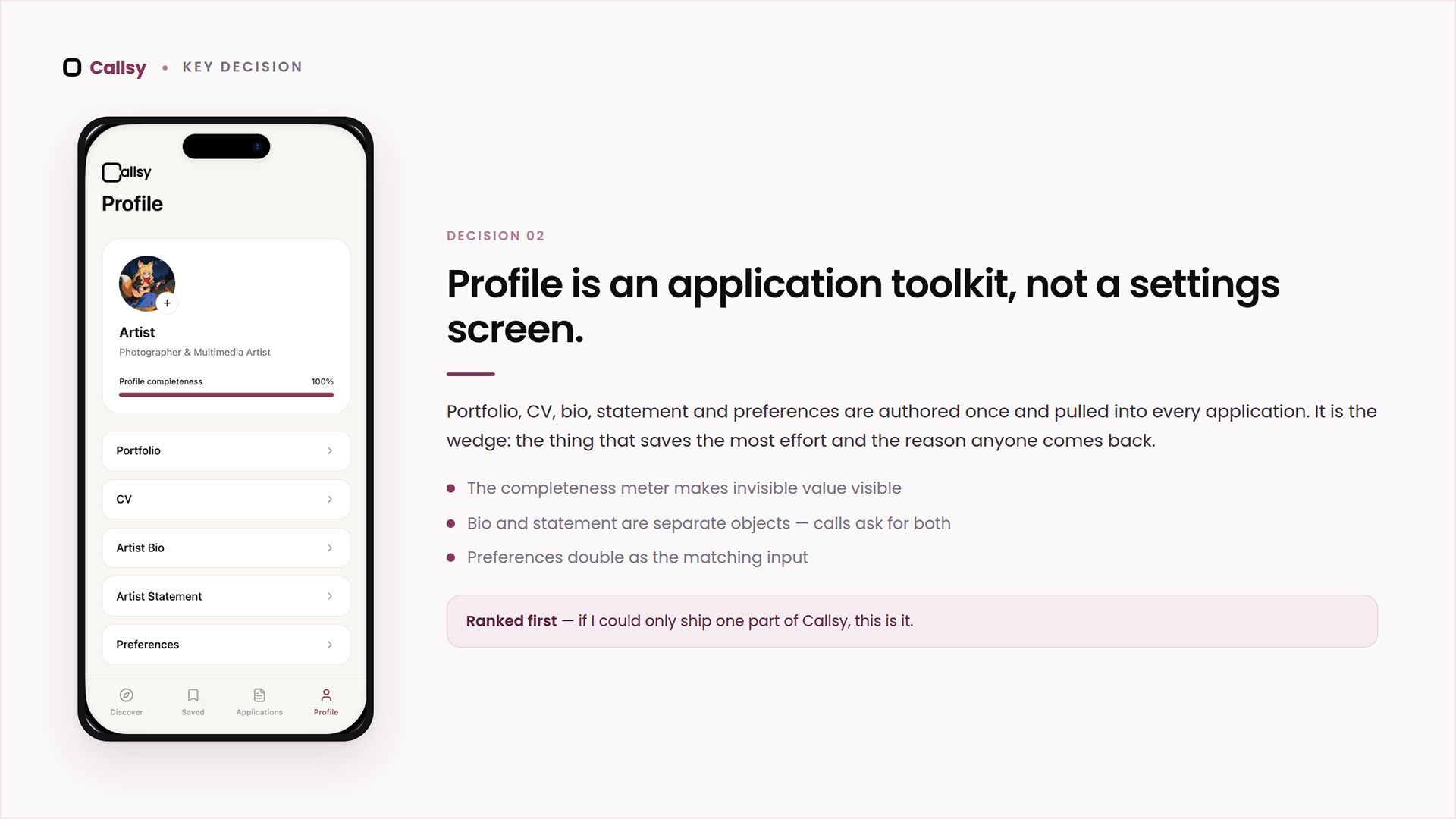
The reusable artist profile
The Profile is an application toolkit, not a settings screen:
Portfolio · CV · Artist Bio · Artist Statement · Preferences
Each item is authored once and reused. The CV is a stored PDF. The bio and statement are editable text with character counts, because almost every application caps them at a different length. Preferences — mediums, opportunity types, location, career stage — feed the matching.
A profile completeness meter runs from 0% to 100%. I added it because the value of Callsy is invisible until the profile is filled: an empty profile means no match scores and no readiness checks. The meter gives the setup work a visible payoff.
Application readiness
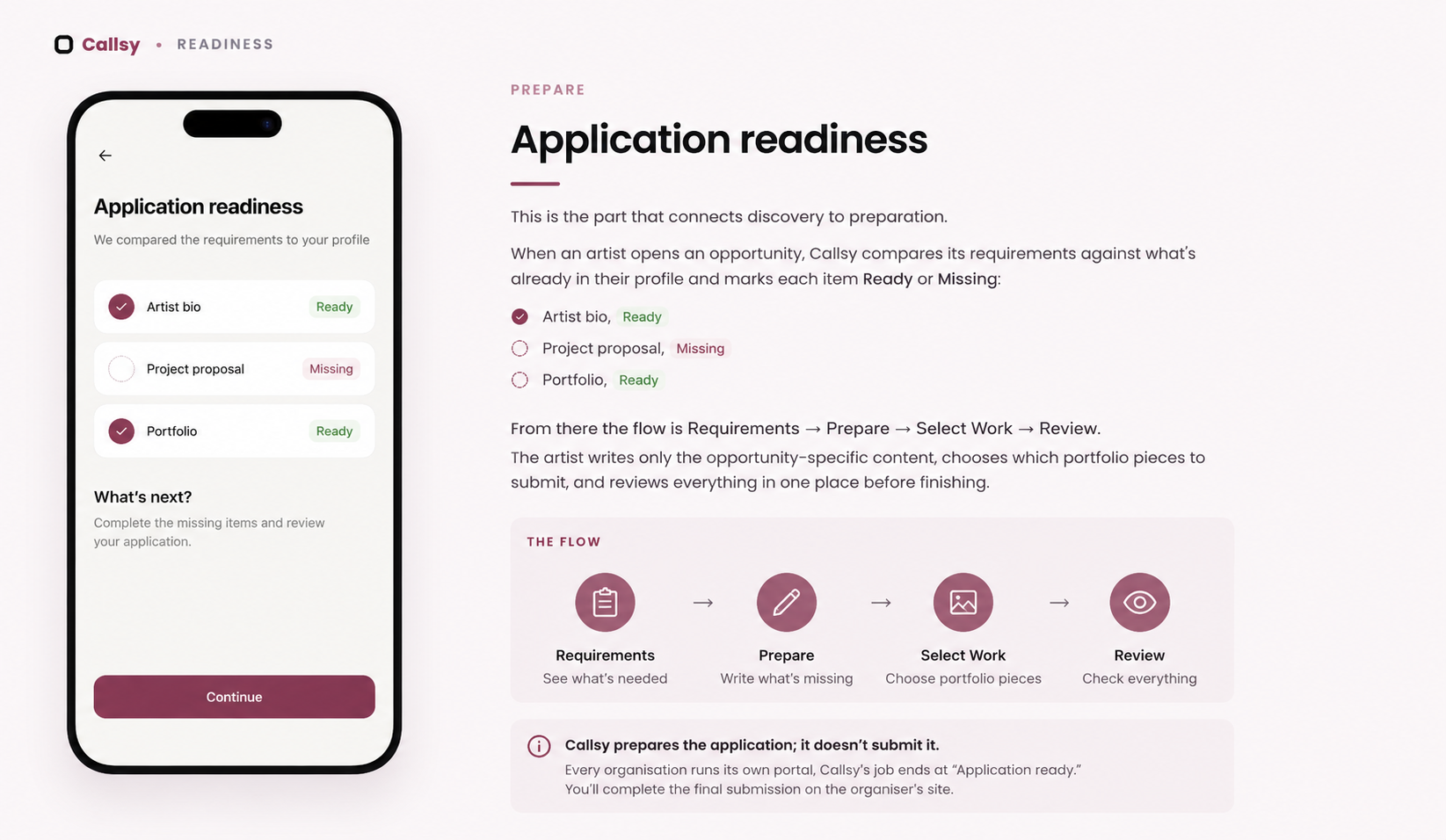
This is the part that connects discovery to preparation.
When an artist opens an opportunity, Callsy compares its requirements against what's already in their profile and marks each item Ready or Missing:
Artist bio, Ready Project proposal, Missing Portfolio, Ready
From there the flow is Requirements → Prepare → Select Work → Review. The artist writes only the opportunity-specific content, chooses which portfolio pieces to submit, and reviews everything in one place before finishing.
Scope decision: Callsy prepares the application; it doesn't submit it. Every organisation runs its own portal, and integrating with all of them isn't realistic. Callsy's job ends at "Application ready" — everything assembled, nothing forgotten — and the artist completes the submission on the organiser's site. I'd rather do one half of this well than both badly.
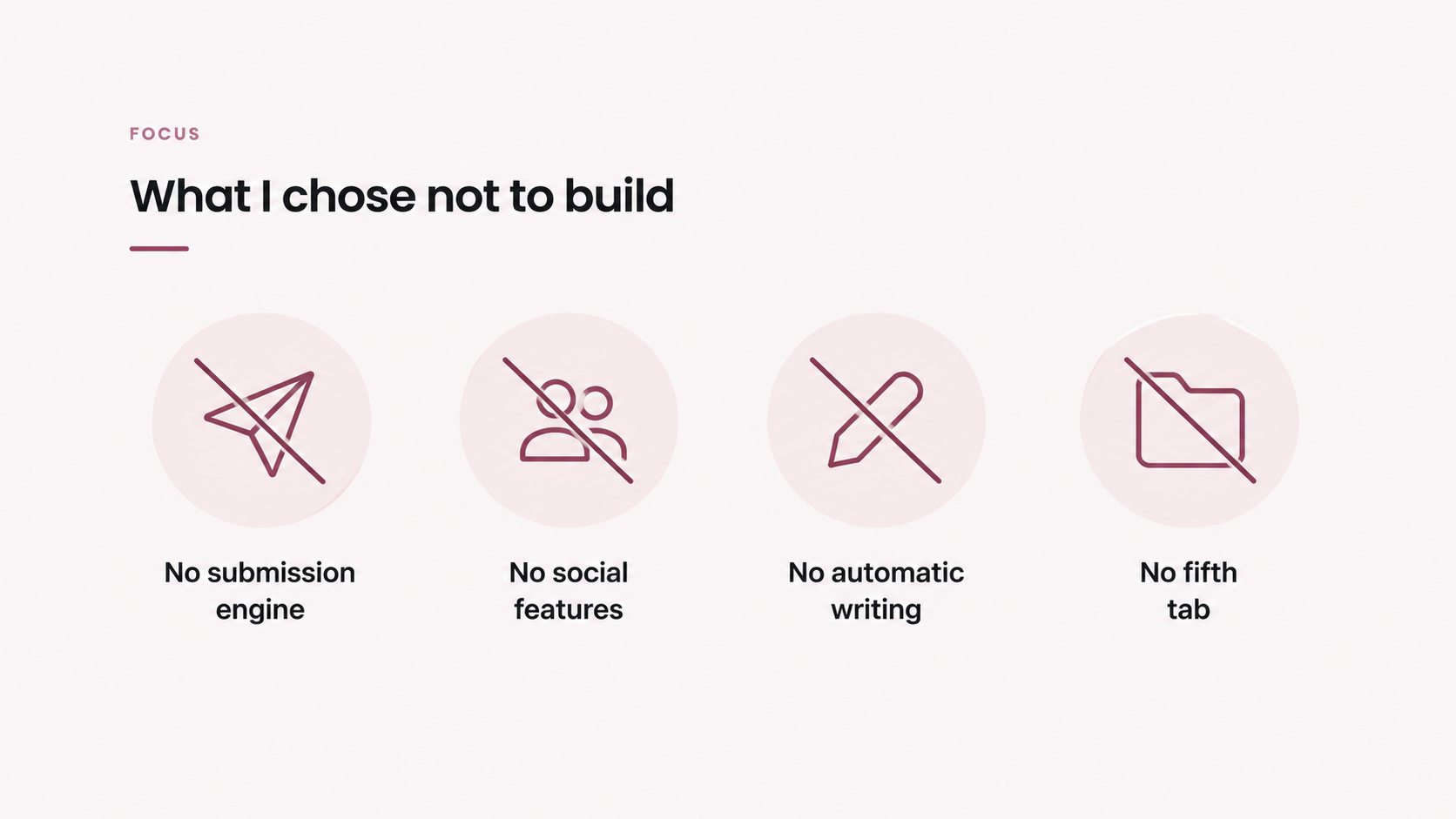
What I chose not to build
A submission engine. Explained above — out of scope by choice.
Social features. Feeds, follows and comments would have made this a network. It's a tool.
Automatic writing. Callsy stores and reuses the artist's own words. Generating a statement for them would undermine the one thing that has to be authentically theirs.
A fifth tab. Applications could have lived inside Saved. I kept them separate because a saved opportunity and a live application are different commitments, and mixing them is what makes bookmark folders useless.
Building it
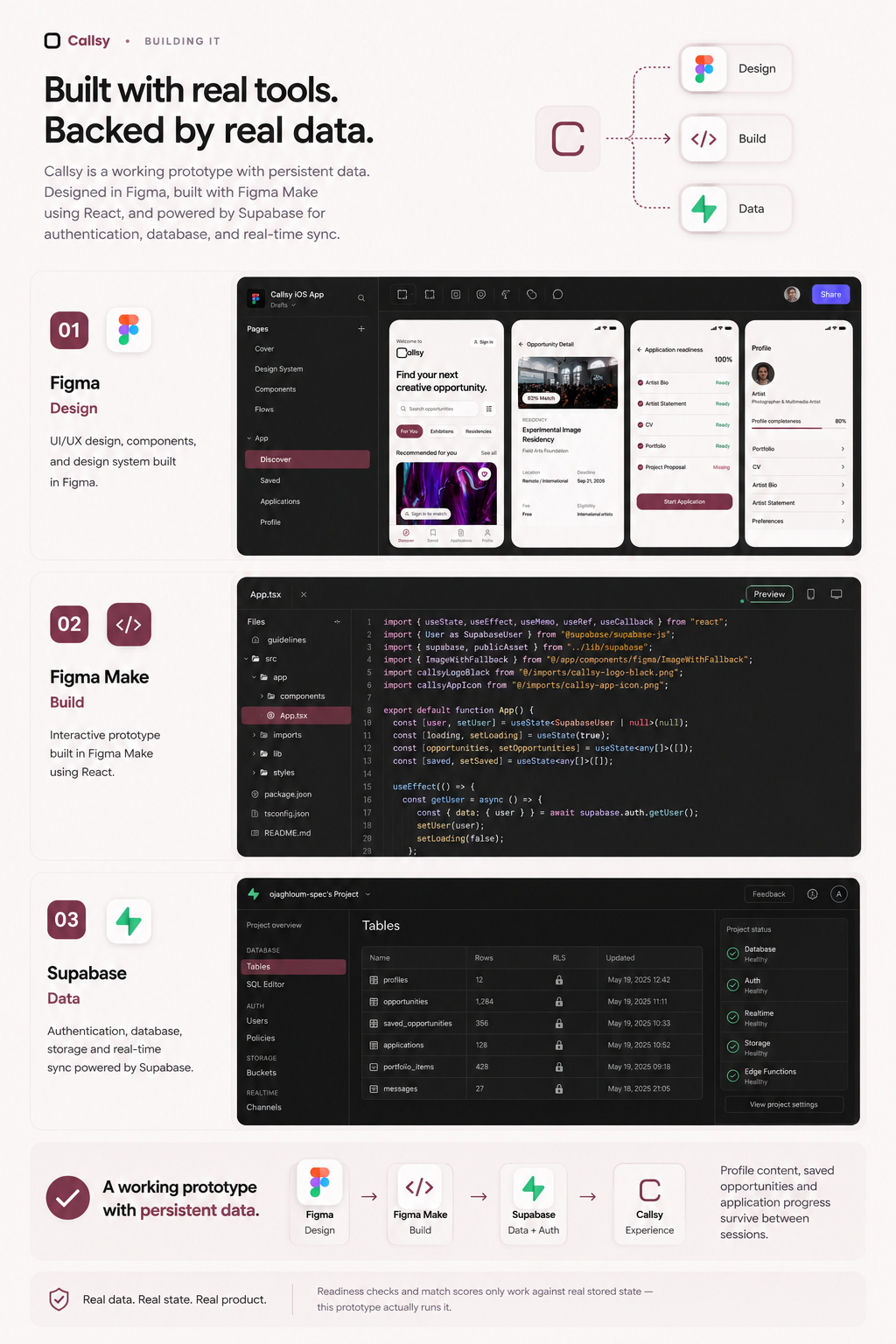
Figma for UX and UI. Figma Make to turn the designs into an interactive, functioning prototype rather than a click-through. Supabase for authentication and persistent data, profile content, saved opportunities and application progress survive between sessions.
That matters more than it sounds: readiness checks and match scores only work against real stored state. A static prototype could show the idea; this one actually runs it.
How I'd measure it
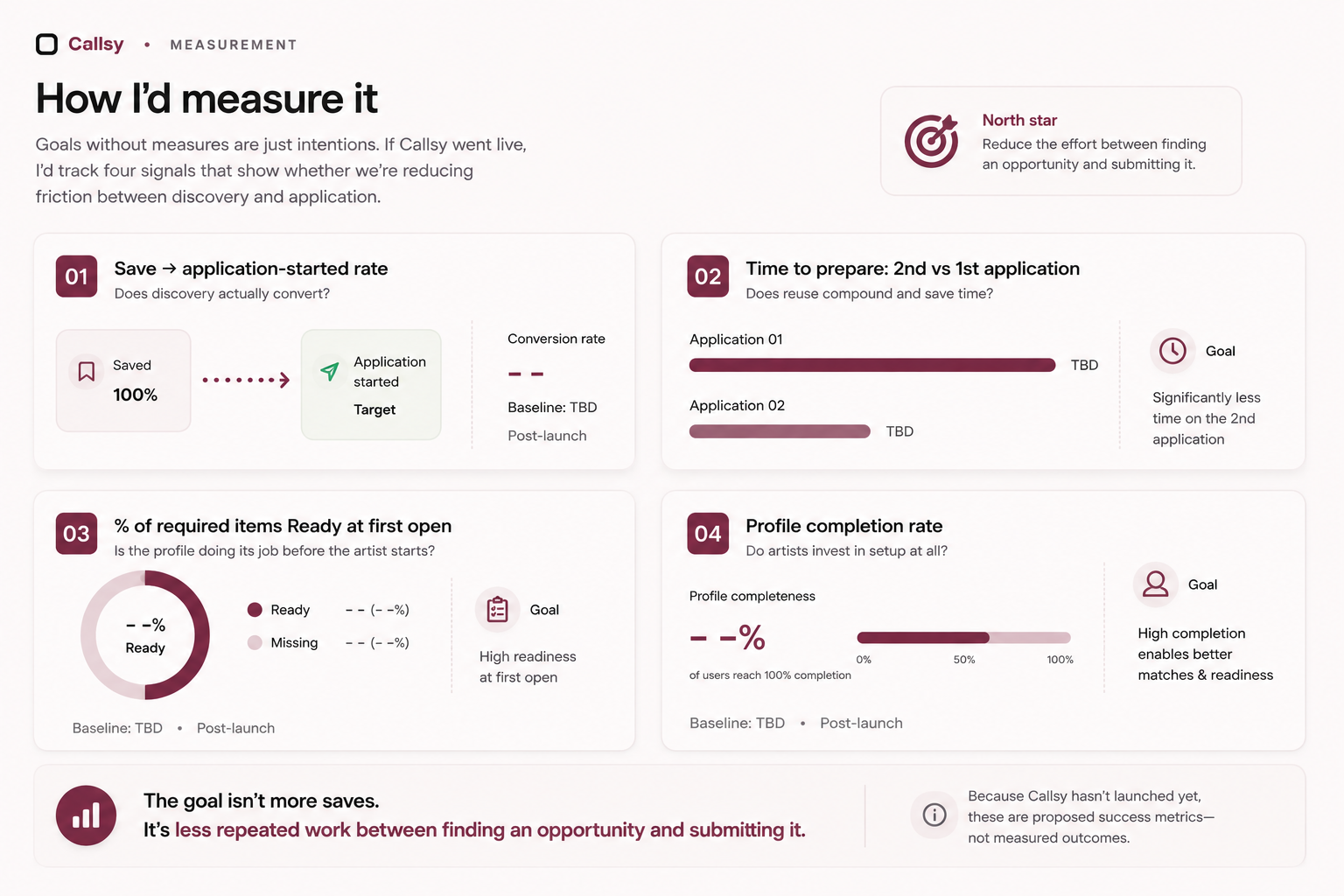
Goals without measures are just intentions. If Callsy went live, I'd watch:
Save → application-started rate, does discovery actually convert?
Time to prepare the second application vs. the first, does reuse compound?
% of required items already Ready at first open, is the profile doing its job?
Profile completion rate, do artists invest in setup at all?
What's next
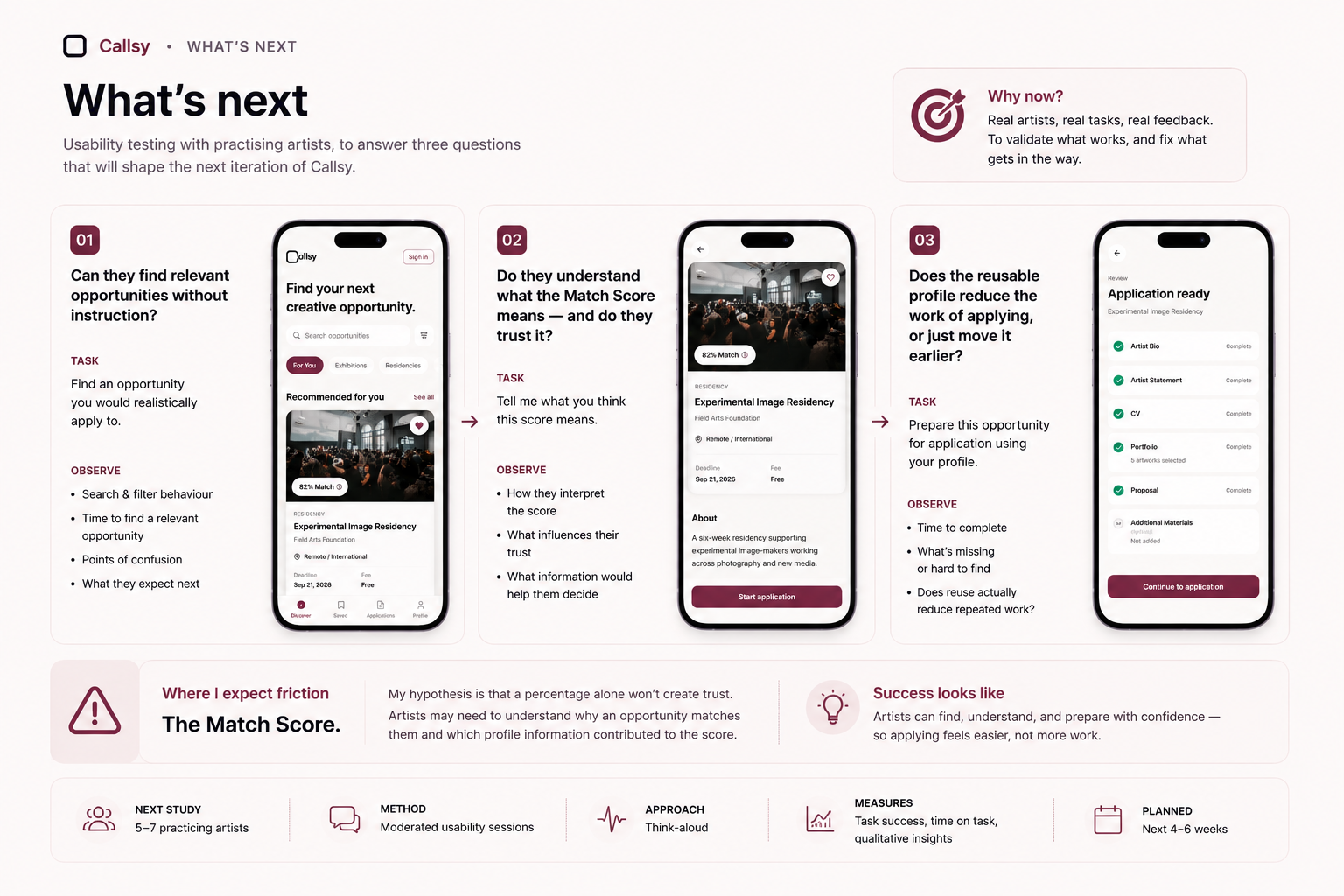
Usability testing with practising artists, to answer three questions:
Can they find relevant opportunities without instruction?
Do they understand what the Match Score means — and do they trust it?
Does the reusable profile actually reduce the work of applying, or just move it earlier?
I expect the Match Score to be where it fails first.
Outcome
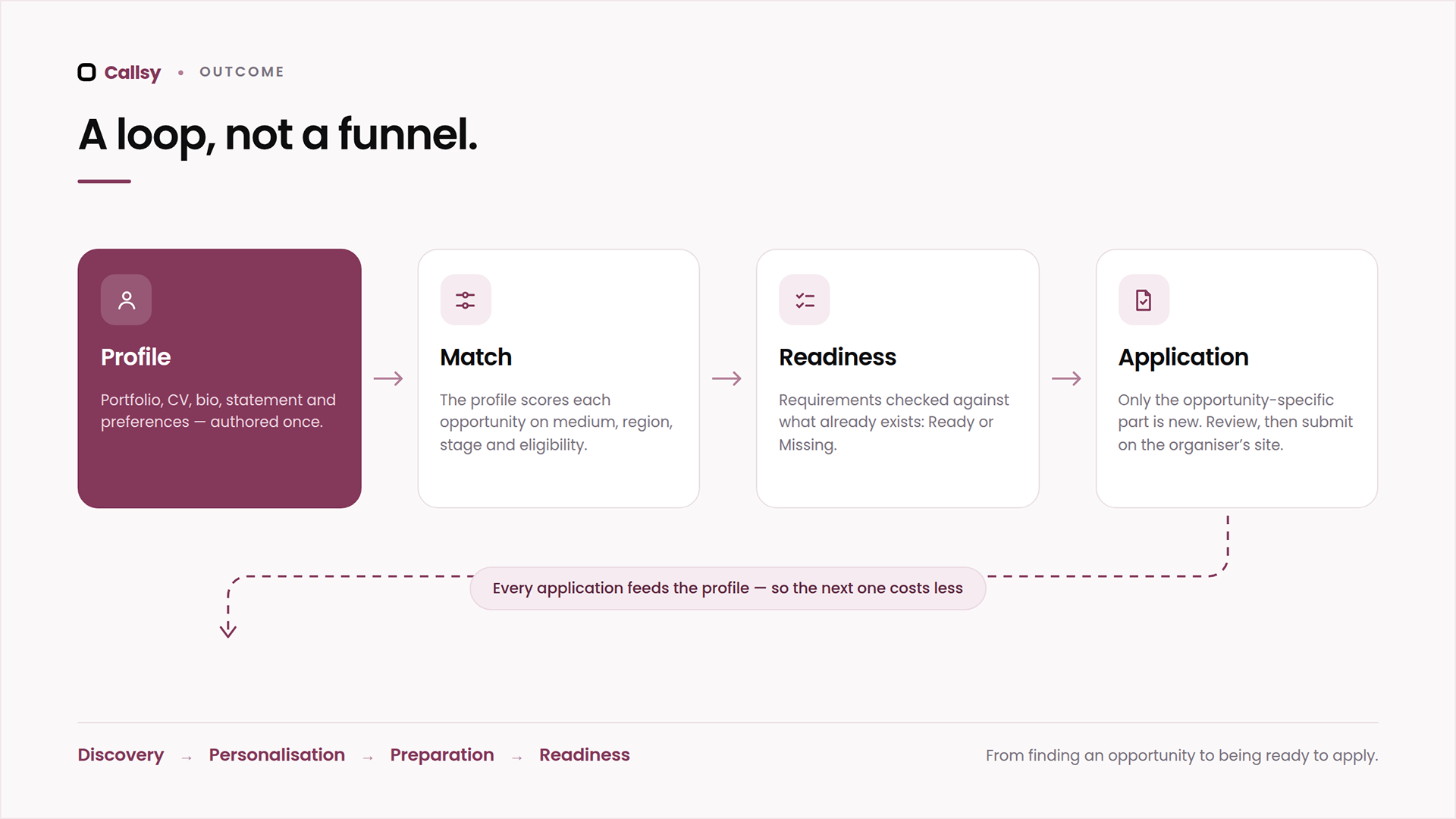
Callsy started as a discovery idea and became something more useful: a loop where the profile feeds the match, the match feeds the readiness check, and the readiness check makes the next application cheaper than the last.
Discovery → Personalisation → Preparation → Readiness
From finding an opportunity to being ready to apply.